Content is scaling faster than your ability to control it
Content is created across teams, tools, and AI at speed, but governance still relies on manual review after the fact. Lytho builds compliance into the workflow, ensuring content is governed as it is created so teams can move faster without added risk.
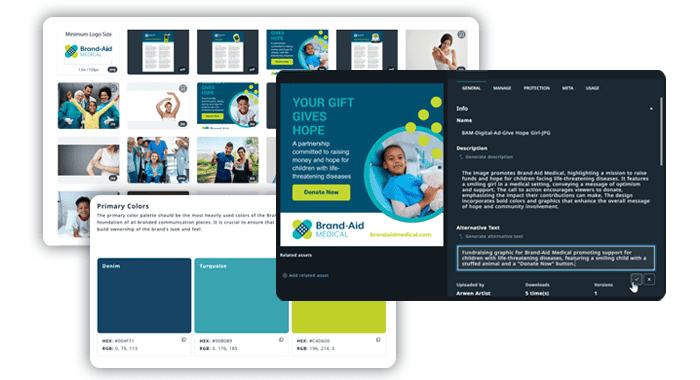

Lytho is a content governance layer that operates across your entire content lifecycle.
Built for compliant content at enterprise scale
Lytho connects workflows, reviews, and governed assets into one compliant content system.


Trusted by teams managing high-volume, high-risk content



Frequently-asked questions about the Lytho Content Governance platform
Lytho is a unified creative operations platform where every product is designed to work together from day one. Creative Workflow, Reviews, DAM, Brand Center, Planner, Tempo, and AI Teammates share a single environment — the same users, permissions, assets, and audit trail run across all of them. There’s no stitching together separate tools or managing integrations between products that don’t natively speak to each other.
This matters most for compliance-sensitive organizations. When intake, production, review, approval, asset management, and brand governance all live in one platform, you get a complete and unbroken audit trail across the entire content lifecycle. An asset requested in Workflow, reviewed in Reviews, approved and stored in DAM, governed by Brand Center, and checked by AI Teammates — that full chain of custody is visible in one place, not reconstructed across five systems after the fact.
For marketing and creative directors evaluating Lytho, the right question isn’t which products you need — it’s which problems you want to solve first. The platform is configured to your workflows and priorities during onboarding, so the capabilities most critical to your team are front and center from the start.
Marketing compliance software manages how marketing content is created, reviewed, approved, and stored so everything published meets brand, legal, and regulatory standards—with an audit trail to prove it. It’s essential for teams in regulated industries (financial services, healthcare, life sciences, CPG) and increasingly valuable for any organization producing high content volume or using AI. Lytho delivers it as part of a unified platform, embedding governance into intake, review, approval, and asset management rather than treating compliance as a separate, after-the-fact check.
Look for compliance that’s built into the workflow, not bolted on afterward. Prioritize structured intake, automated review and approval routing, version control, and a complete audit trail that proves who approved what and when. AI-assisted checks that flag brand, legal, and regulatory issues before content ships are increasingly essential. Lytho delivers all of this in one connected platform—intake, reviews, approvals, DAM, and brand governance share a single audit trail, so compliance is enforced at every step rather than reconstructed after the fact.
Manual review relies on email threads, spreadsheets, and disconnected tools that can’t keep pace with rising content volume or regulatory scrutiny—mistakes slip through and there’s no reliable proof of compliance. Compliance software automates routing, approvals, and audit trails so every step is tracked and documented. With Lytho, marketing, brand, legal, and compliance work in one structured system; only reviewed, approved, on-brand content goes live, and you always have an audit-ready record.
AI accelerates content creation, but without governance it multiplies risk—off-brand messaging, unsubstantiated or non-compliant claims, and no record of who reviewed or approved what. As volume grows, manual oversight breaks down. Lytho is designed to govern content from both human and AI sources, adding structure, accountability, and control across the lifecycle. Its AI Teammates scan content for brand, legal, and regulatory issues as it moves through the workflow, so teams can adopt AI with confidence.
The key is embedding governance into the workflow so review effort doesn’t grow linearly with output. Templated intake, automated routing, self-service brand templates, and built-in audit trails let teams handle higher volume without adding manual checks or compliance gaps. Lytho customers report measurable gains—82% of teams on unified creative workflows see increased content output, and 80% cut revisions to three or fewer—while keeping standards, approvals, and audit trails aligned across teams and regions.
Standalone DAM and project management tools solve different problems in isolation — but creative operations problems live in the space between them. When your intake lives in one tool, your reviews in email, your assets in a DAM, and your campaign calendar in a spreadsheet, nothing talks to anything else and compliance falls through the gaps. Lytho connects intake, production, review, approval, asset management, brand governance, and content planning in a single environment. That means one audit trail, one source of truth for assets and guidelines, and visibility across the entire content lifecycle — without stitching together a fragile stack of integrations.
Lytho is designed for in-house creative and marketing teams that produce a high volume of content and need governance without bureaucracy. That profile exists at mid-market companies as much as at large enterprises. Teams of 10 use it as effectively as teams of 200. The platform scales with you — modular products, configurable workflows, and flexible permissions mean it fits a 15-person in-house agency and a multi-brand global marketing department. If you’re running content through email approvals and shared drives today, Lytho is built to replace that regardless of your company size.
Brand drift happens when teams can’t find the right assets, don’t know the current guidelines, or create content in tools that no governed review process ever touches. For organizations with regional offices, franchise networks, agency partners, or multiple business units, the problem compounds quickly.
Lytho addresses this across every layer of the content lifecycle. Brand Center gives every team member and external partner a single, always-current hub for guidelines and approved assets — so there’s no outdated PDF to work from and no excuse for using the wrong logo. DAM enforces consistency through AI-powered search, expiration controls, and role-based permissions, making the right asset easier to find than the wrong one. AI Teammates extend brand and compliance checks into the tools where content is actually created — inside Lytho’s workflow and, via the Chrome Extension, in any web-based tool your team uses. And because all of this runs on one platform, brand rules defined in Brand Center are enforced by AI Teammates and served through DAM — no cross-referencing, no gaps.
For marketing directors managing brand integrity at scale, this layered approach is what makes consistency achievable across the full organization, not just within the creative team.
Lytho is designed for fast, guided onboarding — not the months-long implementation projects associated with enterprise platforms. Customers consistently describe the process as straightforward, with the Lytho team walking them through each step. Exact timelines depend on the size of your asset library, the number of integrations, and how much taxonomy work is needed upfront — but most teams are up and running in weeks rather than months.
If you have a large or complex migration, Lytho’s professional services team works with you to build the right structure before you go live, so you don’t inherit old chaos in a new system. Because every Lytho product shares the same platform, onboarding covers the full suite in a single implementation — not a separate project for each product.
All three are legitimate DAM platforms, but they serve different buyer profiles. Bynder is optimized for simplicity and speed, making it ideal for marketing teams focused on brand execution — particularly those who want fast access to branded templates and portals. Aprimo is designed for enterprise-scale content operations, offering deep support for workflow automation, governance, and modular content. That power comes with complexity: Aprimo’s implementation is often involved and costly, frequently requiring third-party system integrators and extensive IT involvement.
Lytho sits in a distinct position: it’s built specifically for in-house creative and marketing teams in compliance-sensitive industries that need both a capable DAM and end-to-end creative workflow management — without enterprise implementation overhead. Where Bynder focuses on asset access and Aprimo on content operations at scale, Lytho unifies intake, production, review, approval, asset management, and brand governance in a single platform with a full audit trail. Trusted by more than 600 in-house agency teams, Lytho is the choice for teams that need governance and speed — not a trade-off between the two.
Lytho does not publish pricing publicly — like most enterprise creative operations platforms, pricing is based on your organization’s specific needs, team size, and configuration. The more useful question for internal budget conversations is total cost of ownership. Lytho replaces multiple point tools — a standalone DAM, a project management platform, a separate review tool, a brand portal — reducing both license costs and the overhead of managing disconnected systems. The right way to evaluate Lytho’s price is against the cost of the status quo: lost hours, duplicated assets, compliance incidents, and missed deadlines.
Request a demo to get a quote tailored to your team and use case.
Scale content without scaling risk
Replace reactive review and fragmented tools with a governed system built for modern content operations.